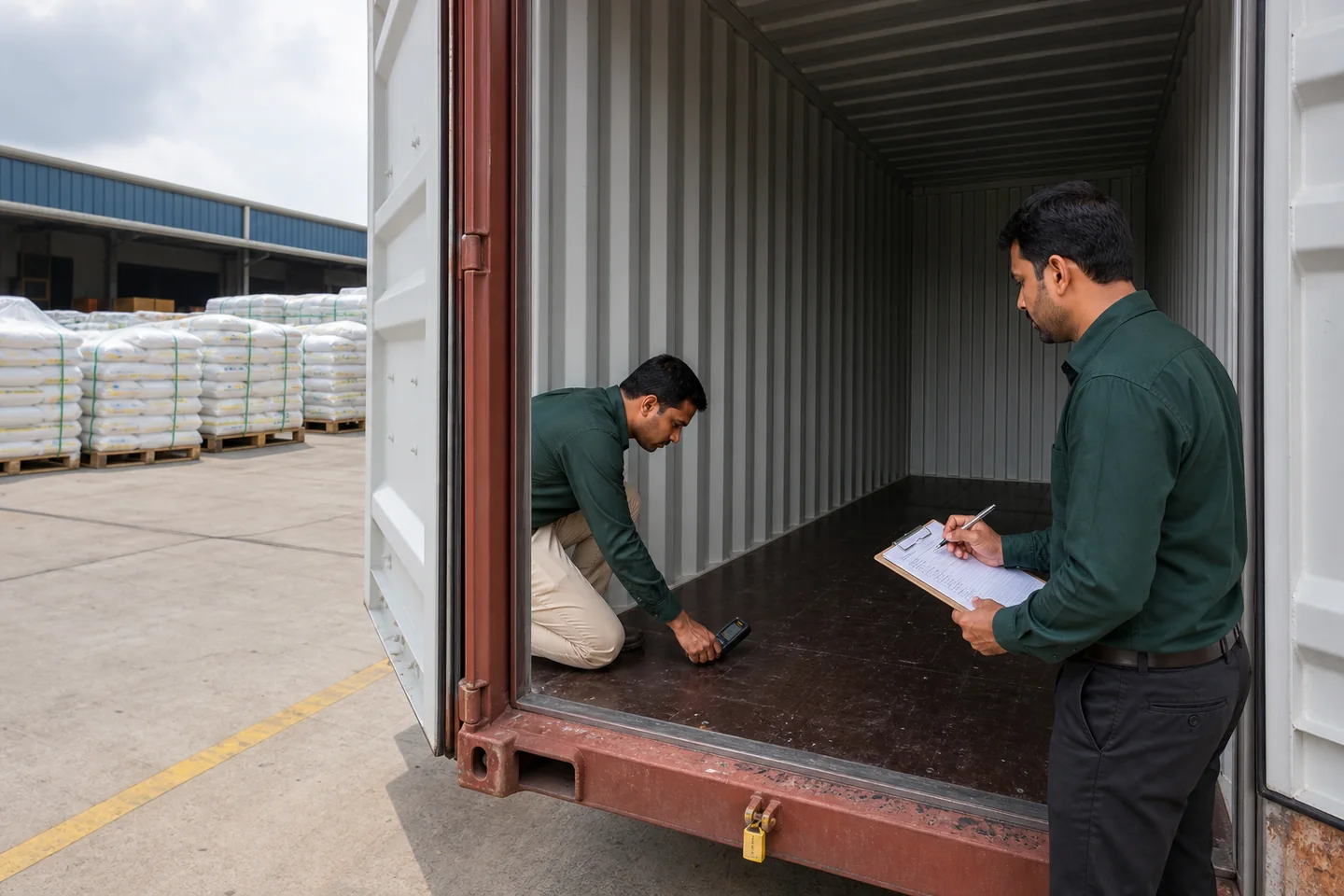
A laboratory-approved product can still arrive damaged if it enters a wet, contaminated or unsuitable container. The loading record should show that the container, cargo, packaging and seal were checked at the same identifiable event—not assembled from unrelated photographs.
Stop-loading rule
Do not pack food cargo into a container with unexplained residue, strong odour, active moisture, visible pests, daylight through the body, damaged door seals or a condition that cannot be safely identified and corrected. Escalate and replace the unit where necessary.
Use a documented inspection—not memory
The joint IMO/ILO/UNECE CTU Code is a global, non-mandatory code of practice for handling and packing cargo transport units. Contracts, carrier rules, food-safety systems and destination requirements may add stricter controls.
For food operations, container preparation also sits within the broader hygiene system. The Codex General Principles of Food Hygiene emphasise contamination control throughout production, storage and distribution.
1. Confirm container identity and basic condition
Before opening
- Container number matches booking/inspection record
- Size and type match the approved load plan
- CSC safety plate and carrier markings are present and legible where required
- Exterior has no major deformation, puncture, unsafe repair or door-frame damage
- Door locking bars, hinges, gaskets and seal points operate correctly
- No conflicting dangerous-goods placards or previous-cargo markings remain
2. Inspect the interior while it is empty
| Check | Acceptable condition | Reason to stop |
|---|---|---|
| Cleanliness | Swept/vacuumed as appropriate; no loose residue, debris or previous securing material | Unknown powder, oil, chemicals, food residue, animal contamination or unsafe material |
| Dryness | Dry floor, walls, roof and door area | Standing water, damp patches, fresh condensation, wet timber or active leak |
| Odour | No abnormal or persistent odour | Chemical, fuel, mould, taint, strong previous-cargo or unidentified smell |
| Pests | No insects, rodents, nests, soil, seeds, plant debris, webbing or droppings | Any live infestation or visible contamination |
| Weather-tightness | Body and doors close correctly; no visible holes | Daylight through roof/walls (apart from designed vents), failed gasket or leak evidence |
| Floor/body | Sound and suitable for load/securing method | Protruding nails, splinters, sharp edges, major floor damage or contamination |
Never enter a container with unknown fumes or residue until hazards are identified and safe-entry procedures are followed. A quick smell test is not an occupational-safety assessment.
3. Release the cargo and packaging
Match the staged cargo to the approved product, lot, quantity and packing specification. Record bag material—such as PP woven or laminated BOPP where agreed—net weight, closure, liner, artwork/version and lot marking. Separate damaged, wet, stained, infested or poorly sealed bags.
- Product/lot matches the released COA or inspection record
- Bag count and average/check weights match the packing plan
- No wet, torn, contaminated or previously repaired bags unless disposition is documented
- Food-contact liners and packaging declarations are available where required
- Lot/date/origin and destination labels match approved artwork
- Cargo moisture and temperature risks are reviewed before sealing the load
4. Control moisture and condensation as a system
Condensation risk depends on cargo moisture, packaging permeability, container condition, route duration, temperature cycles and ventilation. Desiccants, kraft paper, liners, pallets or slip sheets can be useful when selected and installed for the specific risk, but none of them make wet cargo safe.
Ask for the reasoning
Record why a moisture-control measure is used, its type/quantity/location, compatibility with food cargo and who approved it. Prevent direct contact or leakage onto food bags unless the product is specifically designed and approved for that use.
5. Follow a load plan
The plan should account for package dimensions, permitted payload, axle/road restrictions, floor loading, weight distribution, unloading method and cargo movement. Do not use the container’s volume as the only calculation.
During loading
- Keep bags off wet/dirty ground and protect them from rain
- Count and record packages by layer or loading sequence
- Distribute mass and voids according to the approved plan
- Use clean, suitable securing/dunnage materials
- Protect bags from sharp edges and door pressure
- If wooden pallets or dunnage cross borders, verify applicable ISPM 15 treatment/marking
- Maintain batch separation and traceability where multiple lots are loaded
- Take time-stamped progress and final-door photographs under a controlled record
The IPPC explains that ISPM 15 provides a harmonised phytosanitary approach for regulated wood packaging material. Paper, plastic and processed wood products may be treated differently; confirm the destination rule.
6. Close, seal and record the event
- Photograph the final stow before closing the doors.
- Confirm no cargo or protective material obstructs door closure.
- Close locking bars and check gaskets/door alignment.
- Apply the agreed high-security bolt seal at the documented position.
- Record container and seal numbers on the inspection/loading record and draft shipping documents.
- Control any seal replacement with reason, old/new numbers, authority, date and evidence.
A seal shows whether the secured door has been opened or the seal changed; it does not prove product quality or prevent all forms of tampering. Treat it as one layer of chain-of-custody control.
7. Complete verified gross mass correctly
The International Maritime Organization states that SOLAS requires the shipper to provide the verified gross mass (VGM) using an authorised method, and that VGM is a condition for loading a packed container onto a ship. Review the IMO VGM requirements and the competent authority/carrier procedure.
VGM is the packed container’s gross mass—not the commercial net cargo weight. Keep scale/method evidence and transmit VGM by the carrier/terminal cut-off.
Minimum loading evidence pack
| Record | Minimum content |
|---|---|
| Empty-container checklist | Container ID, date/location, inspector, structure, cleanliness, dryness, odour, pests and disposition |
| Cargo release | Product, lot, specification/COA reference, quantity and packaging release |
| Loading tally | Bag/pallet count, batch split, check weights and loading start/finish |
| Photo set | Container exterior/ID, empty interior, staged cargo, loading stages, final stow, closed doors and seal |
| Seal record | Container number, unique seal number, application time and authorised witness |
| Weight record | VGM method/evidence and transmission confirmation |
Buyer checks at destination
- Compare container and seal numbers before opening
- Photograph door/seal condition and any discrepancy
- Open safely and check for shifted cargo, odour, moisture, pests or damaged bags
- Preserve packaging, temperature/moisture evidence and representative samples when a claim may exist
- Notify carrier, insurer, seller and surveyor within contractual time limits
- Do not destroy or rework evidence before claim instructions are received
Buyer questions
Do desiccants guarantee a dry arrival?
No. They are only one control and cannot correct wet cargo, unsuitable packaging, a leaking container or an unassessed route.
Should food bags always be palletised?
No. Floor loading, pallets and slip sheets each have trade-offs. Decide based on package strength, unloading equipment, contamination/pest controls, payload and destination rules. If wood is used internationally, assess ISPM 15.
Is a third-party inspection always required?
Not universally. It may be valuable for first orders, high-risk products, buyer/finance requirements or independent chain of custody. Define scope, sampling authority and reporting before booking it.
Editorial, safety and regulatory note
Organisational author: JFT Agro Trade Desk. Sources were reviewed on 20 August 2026. A named human reviewer approval is not recorded for this version, so no “reviewed by” claim is made. This guide does not replace the CTU Code, SOLAS, carrier instructions, workplace safety rules, food regulations or a qualified surveyor’s advice.