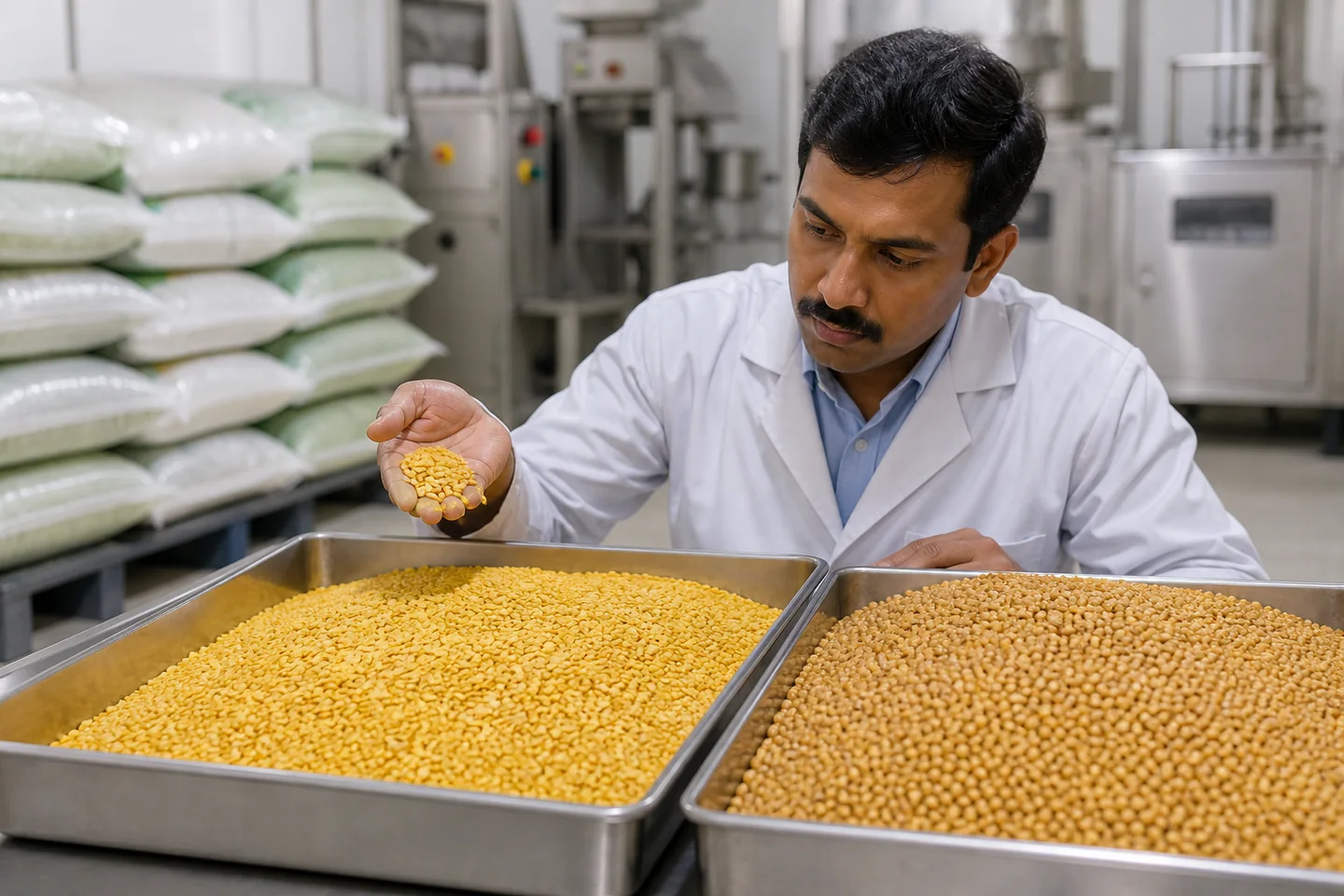
Toor dal, tur dal and arhar dal are trade names for one product — dehulled, split pigeon pea (Cajanus cajan). Buyers should confirm process status, moisture and defect tolerances, food-safety evidence and packing before approving a shipment, rather than relying on the trade name alone.
One product, three trade names
"Toor dal", "tur dal" and "arhar dal" all refer to the same dehulled, split form of pigeon pea. A quotation should still state the botanical identity (Cajanus cajan) alongside whichever trade name the buyer's market uses, since regional naming varies but the contract terms must not.
Whole pigeon pea and dehulled split dal are not interchangeable order terms. State clearly whether the offer is whole, dehulled-split, or dehulled-split with an additional oily or non-oily surface treatment — each is a distinct process status that affects appearance, cooking behaviour and price.
| Decision | What to state | Why it matters |
|---|---|---|
| Process status | Whole, dehulled-split, oily or non-oily treatment | Prevents receiving a different processed form than quoted |
| Moisture | Maximum percentage at loading | Supports storage stability over the transit period |
| Defects | Extraneous matter, broken, damaged and discoloured piece limits | Defines usable yield and grade consistency |
| Crop data | Origin, crop year and processing location | Supports traceability and shelf-life expectations |
| Food safety | Destination-specific residue, mycotoxin and microbiology limits | Supports border clearance and buyer compliance |
Quality sits inside a recognised pulses framework
Pulses intended for direct human consumption, including pigeon pea, are addressed by the Codex Alimentarius Standard for Certain Pulses, CODEX STAN 171-1989 (Rev. 1-1995), a joint FAO/WHO reference covering safety and suitability for consumption. Citing a recognised framework does not replace a lot-specific test: ask for the destination-market limits and a lot-linked certificate of analysis rather than assuming a general standard covers a specific shipment.
Pre-shipment buyer checklist
- Confirm the trade name used matches the contracted botanical identity and process status.
- Write moisture and defect-tolerance limits into the purchase contract, not only the quotation.
- Request a lot-linked certificate of analysis and an approved reference sample.
- Confirm crop year and origin declaration for the specific lot offered.
- Match lot numbers across the packing list, test report and inspection record before release.
Packing and container planning
Packing options and net weight must be confirmed in the quotation alongside the HS code and minimum order quantity — for toor dal this is typically referenced against a single 20-foot full container load, with the exact payload depending on bag construction, palletisation and the carrier's loading limits. Buyer-marked packaging additionally needs artwork and label approval before production.
Release the shipment against matched evidence
| Release item | Evidence to match |
|---|---|
| Identity and process status | Trade name, botanical identity, dehulled/split and treatment declaration, approved sample |
| Physical quality | Measured moisture, extraneous matter, broken and damaged/discoloured piece counts |
| Food safety | Applicable residue, mycotoxin and microbiology limits with a lot-linked report |
| Packing and loading | Confirmed HS code, MOQ, packing option and container loading plan |
| Documents | Matching lot numbers, weights, dates and consignee across all shipment documents |
Important
Food-safety limits and import requirements can change by destination and over time. Confirm current requirements with your importer, competent authority and laboratory before contracting. This guide is procurement information, not regulatory advice.