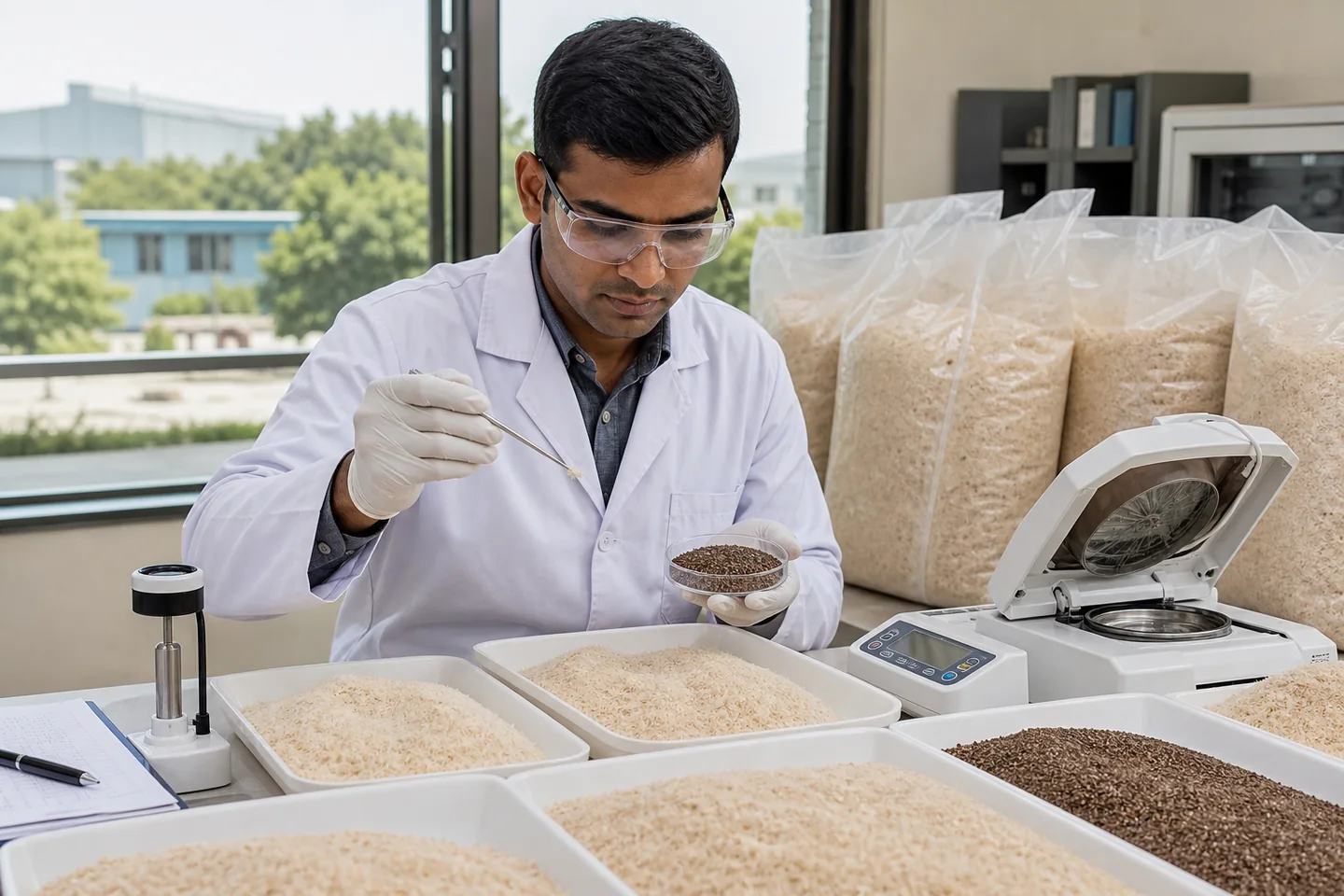
Why India Dominates Global Psyllium Supply

Psyllium (Plantago ovata) grows best in arid, semi-arid conditions with a cool, dry growing season — which describes Gujarat and Rajasthan perfectly. India's Mehsana, Banaskantha (Gujarat) and Barmer, Jalore (Rajasthan) districts account for nearly all of the world's commercial psyllium cultivation.

The crop is harvested between November and March each year. Processing happens in a concentrated corridor of mills around Unjha (Gujarat), which has become the global trading hub for psyllium — the way Rotterdam is to oil. Most importers have never visited a field; they deal with Unjha brokers or exporters.

Competing producers — the USA, Spain, Iran — exist but at a fraction of India's volume. For buyers needing consistent volume above one container per month, India is the only viable source.

Understanding the Four Main Product Forms

Psyllium is not a single product. It comes in four distinct forms, each targeting a different end use. Mixing them up in your PO is the most common and most expensive mistake first-time buyers make.

1. Psyllium Seeds (Whole)

The raw, unprocessed seed harvested from the plant. Small, brown, boat-shaped. Used as a raw material by processing mills in the buyer's country, or in some traditional medicine markets in South Asia and the Middle East.

  • HS Code: 12119020
  • Load per 20ft FCL: 22–24 MT
  • FOB price benchmark (2026): $420–480/MT

2. Psyllium Husk (Isabgol Husk)

The outer seed coat separated from the seed by milling. This is the commercially dominant product — what most buyers mean when they say "psyllium." It is a pale cream, fibrous material with a very high water-absorption capacity (swelling factor). Purity is expressed as a percentage: higher purity means less seed coat fragments, higher swelling factor, and better pharmacopoeial compliance.

3. Psyllium Husk Powder

Ground psyllium husk. Used in food formulations (baked goods, dietary fibre supplements, beverage mixes) where a fine particle size is needed. Typically graded by mesh size (40 mesh, 60 mesh, 80 mesh).

4. Psyllium Seed Powder

Ground whole seed. Cheaper than husk powder. Used as a mucilage/thickener in ice cream, dairy, and industrial applications. Less common in pharma.

Husk Purity Grades and What They Mean

Husk purity grades are the most important spec decision for pharmaceutical and nutraceutical buyers. The numbers refer to the percentage of pure husk material — the rest is unprocessed seed coat fragments and seed material.

Grade Purity Swelling Factor Primary Use FOB 2026 (approx.)
Husk 85%Min 85%Min 40 ml/gFood industry, animal feed$900–1,050/MT
Husk 90%Min 90%Min 45 ml/gDietary supplements, laxatives$1,250–1,450/MT
Husk 95%Min 95%Min 55 ml/gPharma, USP/BP grade products$2,000–2,400/MT
Husk 98–99%Min 98%Min 60 ml/gHigh-purity pharma, EU/US registration$3,500–4,200/MT

Note: Swelling factor (SF) is the most meaningful quality indicator — it measures how much volume one gram of husk absorbs in water. A higher SF means better laxative/fibre efficacy. USP 43 requires a minimum SF of 9 mL/g for psyllium; the Indian grades above far exceed this because the standard was written for a different measurement method. Ask your supplier to provide the SF measured by your pharmacopoeia's specific method.

Key buying tip: Do not rely on purity percentage alone. Two samples both labelled "95% husk" can have swelling factors ranging from 50 to 70 ml/g depending on the milling process and crop quality. Always request a Certificate of Analysis (CoA) with the swelling factor, moisture, and ash content before confirming a purchase order.

Key Technical Specifications to Put in Your PO

A good purchase order for pharma-grade psyllium husk should specify:

  • Purity: Min 95% (or 98% for high-grade)
  • Swelling factor: Min 55 ml/g (IP/BP method)
  • Moisture: Max 12%
  • Ash (total): Max 4%
  • Acid-insoluble ash: Max 1%
  • Heavy metals: Comply with BP/USP limits
  • Pesticide residues: Comply with destination country MRLs
  • Microbial: Total plate count max 10⁵ CFU/g; Salmonella absent/25g; E. coli absent/g
  • Packing: 25kg HDPE bags with inner poly liner, on pallets (if required)
  • Country of origin certificate: Required for most markets
  • Phytosanitary certificate: Required for most markets

Which Markets Import the Most Psyllium from India?

Understanding where the demand comes from helps you benchmark your pricing and understand lead time pressures during peak season.

Market Main Grade Primary End Use Typical Incoterms
USAHusk 95–99%Dietary supplements, OTC laxativesCIF New York / Los Angeles
GermanyHusk 95–99%Pharma excipient (DACH market)CIF Hamburg
UKHusk 90–95%OTC pharmacy, functional foodCIF Felixstowe
NetherlandsHusk 85–95%Food industry, private label supplementsCIF Rotterdam
UAE / GulfSeeds + 85% HuskTraditional medicine, re-exportCIF Jebel Ali
CanadaHusk 95%NHP-licensed supplementsCIF Vancouver / Toronto
AustraliaHusk 90–95%TGA-registered productsCIF Melbourne / Sydney

Pricing and Market Outlook for 2026

Psyllium prices in India are driven by four main factors: crop size, USD/INR exchange rate, competing demand from US and European buyers, and petroleum prices (which affect packaging and freight costs).

The 2025–26 psyllium crop (harvested November 2025 – February 2026) was generally favourable, with good monsoon rains in the Mehsana belt and no significant pest pressure. This has kept prices for 85% and 90% grades relatively stable. Higher purity grades (95%+) remain firm because they require additional milling passes and stricter raw material selection — volume available at these grades is structurally limited.

Key outlook points for buyers contracting in 2026:

  • New-crop prices are typically available from March–April; buyers who contract early (November–January forward) often secure 5–8% better pricing.
  • The US market's demand for psyllium-fortified foods (granola bars, breakfast cereals, functional beverages) continues to grow, creating upward pressure on 85–90% grades.
  • EU buyers face additional cost from pesticide MRL documentation requirements post-2024. Ensure your supplier can provide EU-compliant MRL testing from an accredited lab.
  • Freight from Mundra to Europe runs $1,400–1,700/container (20ft). Psyllium is light and bulky; a 20ft container typically loads only 14–16 MT of husk, making per-MT freight costs higher than dense commodities like rice or sugar.

Regulatory note for pharma buyers

If your psyllium will be used in a licensed pharmaceutical product in the US (USP), UK/EU (BP/EP), or India (IP), your supplier must be able to provide a Drug Master File (DMF) reference or equivalent documentation. Ask specifically:

  • Is the product manufactured in a GMP-certified facility?
  • Can you provide a USP/BP compliant CoA?
  • Is there a US FDA DMF number we can reference in our NDA/ANDA filing?

For nutraceutical/food-grade buyers, these requirements are less stringent — but always request microbial, heavy metals, and pesticide testing from an accredited third-party lab (SGS, Eurofins, Intertek).

Container Loading and Packaging

Psyllium husk is notoriously bulky and light. This has direct implications for your freight and packaging decisions:

  • 20ft FCL load: 14–16 MT for husk (vs 24–26 MT for rice). You pay full container freight for roughly half the weight of a heavy commodity.
  • 40ft FCL load: 22–26 MT. Worth considering if your warehouse can handle the larger delivery.
  • Standard pack: 25kg HDPE woven bag with inner poly liner. Multi-wall paper bags available for premium markets.
  • FIBC/Jumbo bags: 500kg or 1,000kg bags used by large industrial buyers. Saves handling cost, reduces packaging waste.
  • Private label: JFT Agro can print your brand directly on the bags with minimum MOQ of 1 FCL.

How to Place Your First Order

A typical first purchase flows like this:

  1. Request samples. Ask for 100–200g samples of your target grade. A reliable exporter ships via DHL within 48 hours. Test swelling factor, moisture, and microbiological parameters in your own lab or through an accredited service.
  2. Request a CoA for the batch the sample came from. Compare your test results against the CoA — discrepancies are a red flag.
  3. Submit your RFQ. Specify: grade (85/90/95%), quantity in MT, packing type, incoterms, port of discharge, and target delivery month.
  4. Receive Proforma Invoice (PI). Review price, payment terms (typically 30% advance + 70% against scan BL), and loading timeline.
  5. Confirm with payment. Goods are inspected, packed, and shipped. You receive shipping documents (BL, CoO, phytosanitary cert, invoice, packing list) electronically.

JFT Agro Overseas exports psyllium husk and seeds year-round from Mundra and JNPT. We supply to supplement brands, food manufacturers, and distribution companies across Europe, the USA, and the Gulf.