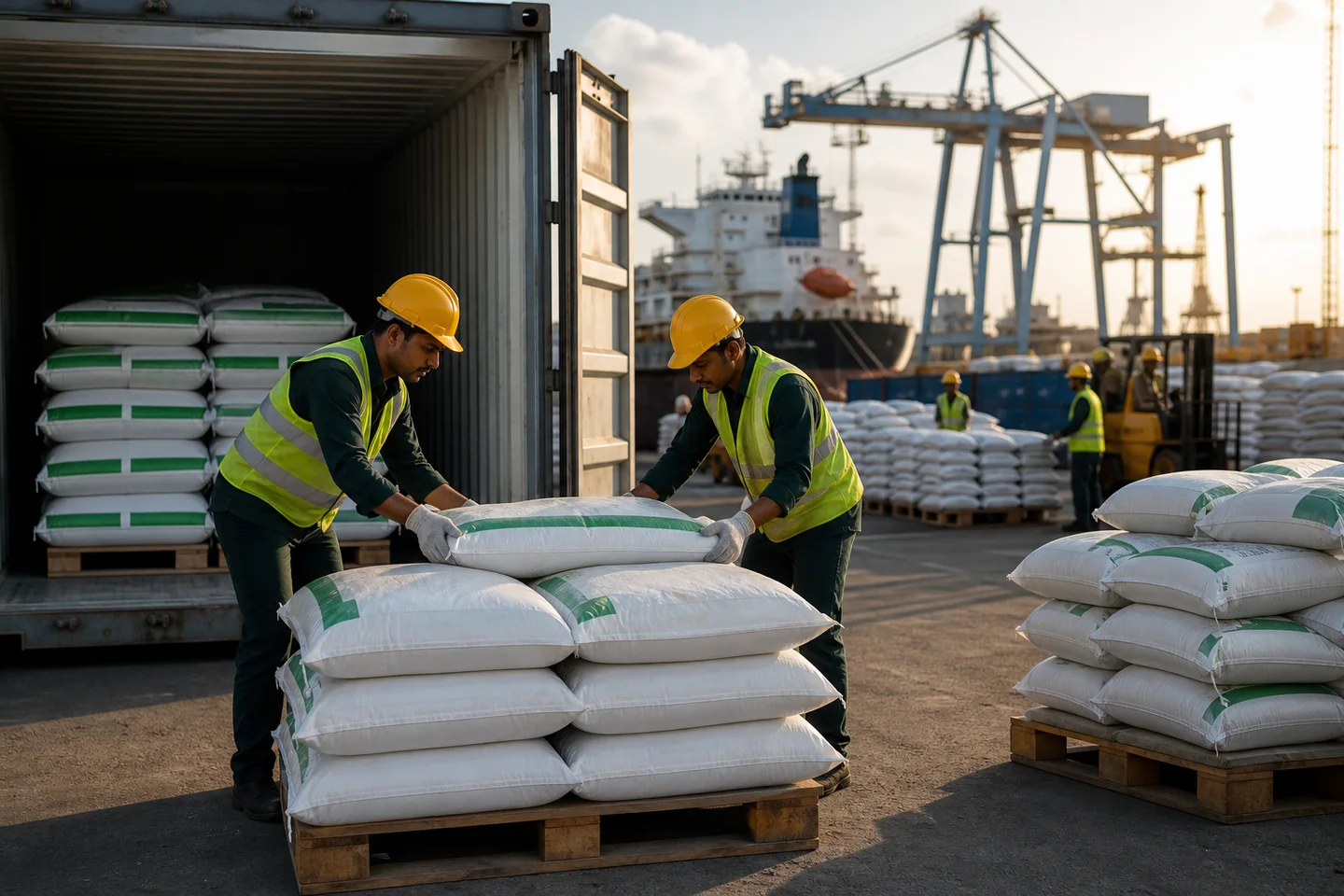
Step 1 — Understand the Export Process (Start to Finish)
Exporting from India to Africa involves a defined sequence. Skipping or mis-sequencing these steps is the most common cause of delays, customs holds, and disputed payments.
Receive Inquiry → Issue Proforma Invoice (PI)
Buyer sends an inquiry (product, quantity, port, incoterms). Exporter prepares a Proforma Invoice with price, specifications, payment terms, and validity period. This is the formal offer. No shipment begins without an agreed PI.
Buyer Accepts PI → Advance Payment or LC Opened
Buyer either pays the advance (typically 30% of invoice value via TT) or opens an Irrevocable Letter of Credit at sight from their bank. Shipment preparation begins only after payment confirmation or LC receipt.
Production / Sourcing → Quality Inspection
Goods are produced, milled, packed, and labelled as per contract specs. Third-party inspection (SGS, Bureau Veritas) is conducted at the factory or port of loading. Inspector draws samples for lab testing (moisture, broken %, pesticide MRL, aflatoxin, etc.).
Stuffing → Custom Clearance at Indian Port
Container is stuffed (loaded) at warehouse or CFS (Container Freight Station). Indian customs agent files the Shipping Bill online via ICEGATE portal. Customs examines (or waives examination based on risk profiling). Let Export Order (LEO) is issued.
Vessel Loading → Shipping Documents Issued
Container loaded onto vessel. Shipping line issues Bill of Lading. Phytosanitary certificate obtained from Plant Quarantine. All export documents compiled (BL, CI, PL, CoO, PC, FC, SGS certificate, CoA) and sent to buyer or buyer's bank.
Balance Payment → Documents Released to Buyer
Buyer pays the balance (70%) against scan BL (or bank releases documents under LC). Original BL sent via courier to buyer or buyer's bank. Buyer uses original BL + other documents to clear customs at African port.
Destination Customs Clearance → Delivery
Buyer's clearing agent presents documents at destination port (Mombasa, Lagos, Cotonou, etc.). Container cleared, duties paid, goods released to warehouse or directly to buyer's distribution point.
Step 2 — The Complete Document Checklist
Every Africa-bound shipment from India requires a specific set of documents. Missing even one document at the destination port can cause days or weeks of delay and demurrage charges running into thousands of dollars.
Step 3 — Payment Terms: Which Is Right for Your Transaction?
Payment terms are the most commercially sensitive part of an India–Africa trade deal. They determine who bears the risk at each stage and directly affect your cash flow. These are the five terms used in practice:
| Payment Term | How It Works | Who Bears Risk | When to Use |
|---|---|---|---|
| 100% Advance (TT) | Buyer pays full invoice value before production begins | Buyer bears full risk | Only for very small, sample orders. High trust required from buyer. Exporter's preferred but buyer should resist. |
| Payment terms are stated only in the signed Proforma Invoice or Sales Contract after buyer, banking and transaction review. Website examples are illustrative and are not payment instructions. | Payment terms are stated only in the signed Proforma Invoice or Sales Contract after buyer, banking and transaction review. Website examples are illustrative and are not payment instructions. | Payment terms are stated only in the signed Proforma Invoice or Sales Contract after buyer, banking and transaction review. Website examples are illustrative and are not payment instructions. | Most common in India–Africa trade. After 2–3 successful shipments, this is the standard term. |
| Irrevocable LC at Sight | Buyer's bank issues a Letter of Credit. Exporter presents shipping documents to their bank. Bank pays immediately on document verification. | Both parties protected — bank is the intermediary | Best for first transactions or large orders (>$50,000). Protects both sides. Adds 1–2% bank charges. |
| Usance LC (60/90/120 days) | LC is issued and documents submitted, but payment comes 60–120 days after document acceptance | Exporter bears deferred payment risk; buyer gets extended credit | For established buyers with good credit history. Common in West Africa for large distributors. |
| Documents Against Payment (D/P) | Bank holds original BL until buyer pays. Buyer cannot take delivery without paying. | Exporter bears risk of buyer refusing payment after goods arrive | Used between established partners when LC is too expensive. Less common in India–Africa trade. |
Step 4 — Country-Specific Requirements at a Glance
| Country | Main Port | Transit (Days) | Mandatory Extra Docs | Import Duty (Rice) |
|---|---|---|---|---|
| Nigeria | Apapa (Lagos), Onne | 16–22 | Form M, NAFDAC, SON SGS | 110% + VAT 7.5% |
| Benin (Cotonou Hub) | Cotonou | 16–20 | SGS (BIVAC), TCI | 5–20% (re-export hub) |
| Togo | Lomé | 16–20 | COTECNA inspection | 15% CET |
| Ghana | Tema | 17–22 | GSB inspection (BIVAC) | 20% + ECOWAS levy |
| Kenya | Mombasa | 16–20 | KEBS PVoC (SGS/BV/Intertek India) | 75% EAC CET |
| Tanzania | Dar es Salaam | 16–20 | TBS inspection | 75% EAC CET |
| South Africa | Durban, Cape Town | 20–26 | SABS, DAFF phyto import permit | 0–10% (ITAC tariff) |
| Ethiopia | Djibouti (landlocked) | 18–24 | QSAE certification | 0–30% depending on product |
| Senegal | Dakar | 18–23 | COTECNA inspection | 10% CET |
| Mozambique | Beira, Maputo | 18–24 | Standard + SGS inspection | 2.5–7.5% + VAT 17% |
Step 5 — Incoterms for India–Africa Trade
Incoterms define who pays for freight, insurance, and when risk passes from seller to buyer. Choose the wrong one and you'll have expensive disputes.
| Incoterm | What Exporter Pays | Risk Passes | Most Common For |
|---|---|---|---|
| FOB (Free On Board) | All costs until goods loaded on vessel at Indian port | When goods cross ship's rail at loading port | Buyers who arrange their own freight. Large buyers with shipping contracts. |
| CNF / CFR (Cost & Freight) | FOB + ocean freight to destination port | When goods loaded on vessel (same as FOB) | Most common in India–Africa rice and spice trade. Buyer arranges insurance. |
| CIF (Cost, Insurance, Freight) | FOB + ocean freight + marine insurance to destination port | When goods loaded on vessel | Most buyer-friendly. Standard for first transactions. Bank LCs almost always require CIF. |
| DDP (Delivered Duty Paid) | Everything including destination duties and last-mile delivery | At buyer's warehouse door | Rare in agro trade. Extremely complex for exporter. Avoid. |
JFT Agro recommendation on incoterms
For African buyers, CIF to destination port is the safest option for your first 3–5 orders. It fixes your total import cost before the goods leave India, there is nothing hidden, and your LC bank accepts it cleanly. Once you have freight rate relationships with shipping lines and want to optimise costs, switch to FOB and arrange your own freight.
Free Downloadable Document Templates
Below are the three most important export document templates — Proforma Invoice, Commercial Invoice, and Packing List — formatted to Indian export standards and ready to print or copy. Click the tabs to switch between documents. Use the Print button to save as PDF.
Step 6 — Common Mistakes Indian Exporters Make When Shipping to Africa
- Shipping before Form M is confirmed (Nigeria). The Form M number must appear on your commercial invoice and BL. If it's missing, the goods simply cannot clear Nigerian customs — full stop. Always get confirmation of Form M number in writing before stuffing the container.
- Not getting pre-shipment inspection in time. KEBS PVoC, SON inspection, and similar take 3–5 working days to schedule in India. If you book inspection the day before vessel cut-off, you will miss the vessel.
- Description mismatch across documents. If your PI says "IR-64 Parboiled Rice 5% Broken" but your BL says "Rice" and your phytosanitary says "Paddy Rice," destination customs will query every document. Use exactly the same product description wording across all seven documents.
- Not declaring actual CIF value. Under-invoicing to reduce the buyer's import duty is fraud in both India and the destination country, and is a common cause of shipment seizure. Declare actual values.
- Sending non-original BL when buyer needs original. Most African countries require original BL for customs clearance. A scanned copy of BL allows the buyer to see documents, but they cannot clear customs with it. Always clarify BL type required before vessel booking.
- Phytosanitary certificate expiry. Indian PCs are valid 21 days. If there is a vessel delay, port congestion, or schedule change, the PC may expire mid-voyage. Get a fresh PC before the original expires — your clearing agent at destination will check the date.
Step 7 — Transit Times from India to Major African Ports
| Indian Port | African Port | Shipping Line Examples | Transit Days | Frequency |
|---|---|---|---|---|
| Mundra / JNPT | Mombasa (Kenya) | MSC, CMA CGM, Maersk | 16–20 | 2–3 sailings/week |
| Mundra / JNPT | Dar es Salaam (Tanzania) | MSC, ONE, Evergreen | 16–21 | 2 sailings/week |
| Mundra / JNPT | Lagos / Apapa (Nigeria) | MSC, Maersk, CMA CGM | 18–23 | 1–2 sailings/week |
| Mundra / JNPT | Cotonou (Benin) | MSC, CMA CGM | 17–22 | 1–2 sailings/week |
| Mundra / JNPT | Tema (Ghana) | MSC, Hapag-Lloyd | 18–23 | 1 sailing/week |
| Mundra / JNPT | Durban (South Africa) | MSC, Maersk, ONE | 22–27 | 2–3 sailings/week |
| Mundra / JNPT | Djibouti (Ethiopia corridor) | MSC, CMA CGM, X-Press | 8–12 | 2–3 sailings/week |
| Tuticorin | Mombasa | X-Press Feeders, MSC | 10–14 | 1 sailing/week |
Booking your shipment: timeline to follow
- T-21 days: Confirm purchase order and PI. Receive advance payment.
- T-18 days: Begin production / sourcing. Book pre-shipment inspection (SGS / KEBS PVoC agent).
- T-14 days: Book container with shipping line. Confirm vessel schedule and CFS cut-off date.
- T-10 days: Complete packing. Schedule pre-shipment inspection visit.
- T-7 days: Apply for Phytosanitary Certificate (PQIMS portal). Prepare all export documents.
- T-5 days: File Shipping Bill on ICEGATE. Stuff container at CFS.
- T-3 days: Obtain LEO (Let Export Order) from Indian customs. Gate-in container at port.
- T-0: Vessel sails. Bill of Lading issued. Send scan of all documents to buyer.