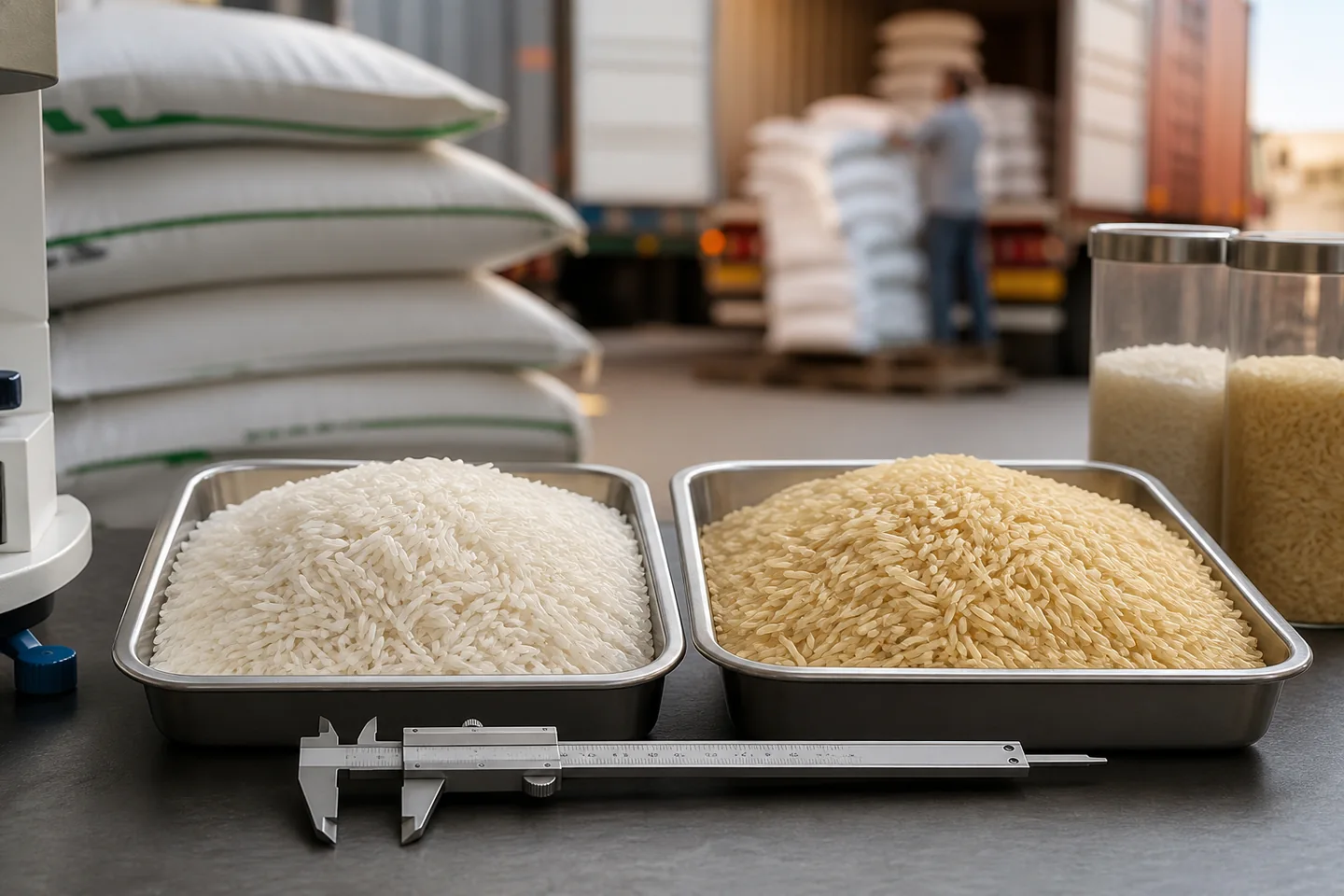
Start with the official variety identities
India’s Agricultural and Processed Food Products Export Development Authority defines Basmati as long-grain aromatic rice associated with the Himalayan foothills of the Indian subcontinent. The Indian Agricultural Research Institute records Pusa Basmati 1121 and Pusa Basmati 1509 as separately released varieties with different agronomic characteristics.
Primary references: APEDA’s Basmati profile, ICAR’s Basmati varieties page and IARI’s rice-variety records.
1121 versus 1509: what the official records establish
| Field | Pusa Basmati 1121 | Pusa Basmati 1509 |
|---|---|---|
| Release record | Released as Pusa 1121 in 2003 and notified as Pusa Basmati 1121 in 2008 | Released in 2013 |
| Official maturity reference | About 145 days in IARI’s variety record | About 115 days in IARI’s variety record |
| Official defining points | Extra-long slender, aromatic grain and high cooked-kernel elongation | Early-maturing, reduced-height, non-lodging and non-shattering variety |
| What still requires a contract | Processing form, grain measurements, moisture, broken percentage, foreign matter, ageing, crop or lot, packing, inspection and documents | |
Do not confuse variety with processing form
A request for “1121” or “1509” is incomplete. Buyers should also state whether they require raw, steam, white sella or golden sella, and then define the lot specification. JFT’s existing product pages separate these intents:
- 1121 Basmati rice hub
- 1121 raw Basmati rice
- 1121 steam Basmati rice
- 1121 white sella Basmati rice
- 1509 steam Basmati rice
- 1509 golden sella Basmati rice
When 1718 or 1401 enters the shortlist
Pusa Basmati 1718 and Pusa Basmati 6 (Pusa 1401) are also distinct variety identities, not processing descriptions. ICAR describes 1718 as a bacterial-blight-resistant version derived from Pusa Basmati 1121, while IARI records Pusa 1401 as a variety released in 2008. These official agronomic facts help confirm identity; they do not predict whether a steam, white-sella or golden-sella lot will meet a buyer’s cooking and commercial requirements.
- Compare 1718 steam Basmati rice with 1718 golden sella Basmati rice.
- Compare 1401 steam Basmati rice with 1401 sella Basmati rice.
- If the RFQ says only “sella,” confirm whether the requested presentation is white or golden before comparing offers.
Market context without assuming buyer preference
APEDA’s 2025–26 Basmati profile identifies Saudi Arabia, Iran, Iraq, the UAE, Yemen and the USA as major destinations. This supports market relevance but does not establish that every buyer in those countries wants the same variety or processing form. Confirm the buyer’s channel, cooking test, pack format, label and target price before recommending a product.
See JFT’s India–UAE trade hub and Europe and CIS market overview for market-level planning.
How to request comparable 1121 and 1509 quotes
Ask each shortlisted supplier to quote against the same written fields:
- Variety and processing form.
- Average grain length and the measurement method.
- Moisture, broken grains, foreign matter, damaged or discoloured grains and purity.
- Crop or lot, ageing requirement and approved reference sample.
- Bag construction, net weight, artwork, marking and pallet requirement.
- Quantity, destination port, shipment window, Incoterm and quote validity.
- Inspection, COA and destination-document requirements.
Why this guide does not publish a fixed FOB price
Variety, processing form, crop or lot, ageing, quality tolerances, packing, quantity, inspection, port, freight, payment terms and quote validity can all change the commercial offer. A static price range can therefore mislead buyers. JFT Agro confirms firm terms in the Proforma Invoice after reviewing a complete specification.
First-order decision sequence
- Write the intended variety, form and measurable quality parameters.
- Request representative samples subject to availability and agreed courier terms.
- Run the buyer’s agreed appearance, cooking and laboratory checks.
- Approve the reference sample and final specification in writing.
- Compare offers only when packing, Incoterm, inspection and document scope match.
Use the purchase specification guide and sample request page for the next step.
Buyer conclusion
Choose between 1121 and 1509 using the buyer’s required identity, cooking result and commercial specification—not a generic country assumption. Then select the processing form, approve a representative sample, and record every acceptance parameter in the contract documents.